CERAMICS RESEARCH CENTRE–UK
The Ceramics Research Centre (CRC-UK) is led by Professor Clare Twomey and its current members are Research Associate Phoebe Cummings, Senior Lecturer Tessa Peters, Emerita Professor Christie Brown, and Emeritus Professor Nigel Wood.
The CRC-UK is a leader in debates surrounding international contemporary ceramic practice. Its work has been central to the re-evaluation of the position of ceramics in contemporary art and museum culture. The members’ practice-based and theoretical investigations of ceramic installation and the associated dialogues around museum intervention, curatorial practice and audience engagement have had an impact on gallery and museum policy. In generating new ways of thinking and creating new forms of artistic expression their work has had an influence beyond the academy and increased public engagement with contemporary ceramics. The field of research has additionally been developed through the work of the Centre’s doctoral students and recent PhD successes.
The CRC-UK developed from the interface between teaching and research based on the historic Harrow Ceramics course which ran from 1963 until 2012. During the first decade of the 21st century, research staff Edmund de Waal and Christie Brown began to explore a strategy to address new agendas in the field, joined in 2004 by Clare Twomey. In 2022, the Centre was awarded the highest level of recognition for its impact by the Research Excellence Framework (REF) specifically for transforming the curatorial strategies of major art institutions to the benefit of visitors and emerging ceramics artists; diversifying the audiences for craft-based arts, through raising the mainstream media profile of such arts and through direct engagement with underserved communities; and changing Tate Modern’s approach to public participation, to the benefit of the institution and its associates.
CALL FOR PAPERS
Permanence / Impermanence: Collecting and archiving contemporary clay practices
Conference, London, 24-26 June 2026
Deadline for proposals: 16 March 2026
Conference organisers: Ceramics Research Centre-UK, CREAM, University of Westminster, in partnership with the Victoria and Albert Museum.
The conference addresses how artworks in the ‘expanded field of clay’ can be made accessible and visible to current and future audiences.
Artists’ practices in the expanded field of clay can result in raw clay artworks, large-scale site-specific installations, performance-based events and involve audience participation (Brown, Stair and Twomey, 2016). Due to their ephemeral or mutable nature, such works pose significant challenges to museums, which have more often acquired permanent ceramic objects due to the complexities of capturing live or transient clay artworks.
The conference takes place in the context of important recent work on collecting performance, installation and live art (Tate, 2018-22; Hölling, Feldman & Magnin, 2023-4), and on the politics and practices of museum collecting (Jones, 2021; Krmpotich & Stevenson, 2024).
Proposals are invited from artists, academics and museum professionals, including archivists, conservators, curators, collection managers, learning officers and others. Proposals may take any of the following formats: 10-minute provocations that ignite debate, 25-minute papers and 60-minute panel discussions. We particularly welcome case studies of artworks, acquisitions, exhibitions, interventions or other museum projects. Presenters may address issues relating to, although by no means limited to, the following themes and questions:
Artists / Artworks / Projects:
- How can artists be active in the process of their artworks being represented in collections?
- Object, concept, experience, process? What is it that museums are collecting?
- Can the re-performance of a work or its translation to a different medium be a productive, rather than reductive, process?
- Outside of documentation through photography and videography, how might the physical sensations of interacting with a work, beyond sight, be preserved when it no longer exists in the same form?
Museums:
- How are museums engaging with the expanded field of clay practice through collections, learning programmes, and other activities?
- What are the implications if these artworks are not collected in a sufficiently meaningful way?
- What is the impact on visitors and institutions when working with ephemeral, performance-based, participatory and site-specific ceramic or clay artworks?
- What are the challenges of stewarding and/or documenting contemporary clay artworks, including issues of care, ethics and long-term availability, and how can museums meet them?
- How can museums welcome, accommodate or document intentional decay in ephemeral artworks?
Collections / Archives:
- What can be learned from the strategies of collecting other kinds of ephemeral art practices, such as performance, digital and hybrid objects?
- Do the nuances of materiality inherent in experimental clay and ceramic practices pose particular challenges?
- Collections or archives? Where can transient artworks be best represented for the future?
Timeline
16 March 2026: Deadline for proposals (max. 300 words + 100-word biography per presenter/panel member).
Submit proposals to: Ceramics@westminster.ac.uk
Early April 2026: Notification of acceptance.
Mid-April 2026: Registration opens.
The conference is staged in the first year of the AHRC-funded Future Ecologies of Clay research project (August 2025-July 2028) with the objective of gathering information on the experiences and needs of artists, museums and researchers. It is the first event of a ‘long conference’, which reconceptualises the notion of the conference-as-catalyst and functions as a means to develop ideas and approaches within a follow-on seminar series and summit day. Conference presenters will initially be invited to contribute to the project website, and selected conference papers and research findings will be published in an edited book of essays in 2028.
The Future Ecologies of Clay research involves creating four new artworks with four UK museums, including the V&A. These practice-based case studies of ephemeral, site-specific, participatory and live art will provide new content for each museum’s collection. An Open Call for museums interested in participating will be publicised in Spring 2026.
The Future Ecologies of Clay research is being undertaken by the Ceramics Research Centre-UK in partnership with the V&A. This work is supported by the Arts and Humanities Research Council [grant number UKRI748].
References:
Brown, C., Stair, J., & Twomey, C. (eds.) (2016), Contemporary Clay and Museum Culture, Routledge.
Hölling, H. B., Feldman, J. P., & Magnin, E. (eds.)(2023-4), Performance: The Ethics and the Politics of Conservation and Care, Vols. 1 & 2, Routledge.
Jones, M. (2021), Artefacts, Archives and Documentation in the Relational Museum, Routledge.
Krmpotich, C., & Stevenson, A. (eds.) (2024), Collections Management as Critical Museum Practice, UCL Press.
Tate (2018-22), Reshaping the Collectible: When Artworks Live in the Museum: https://www.tate.org.uk/research/reshaping-the-collectible
EXHIBITIONS
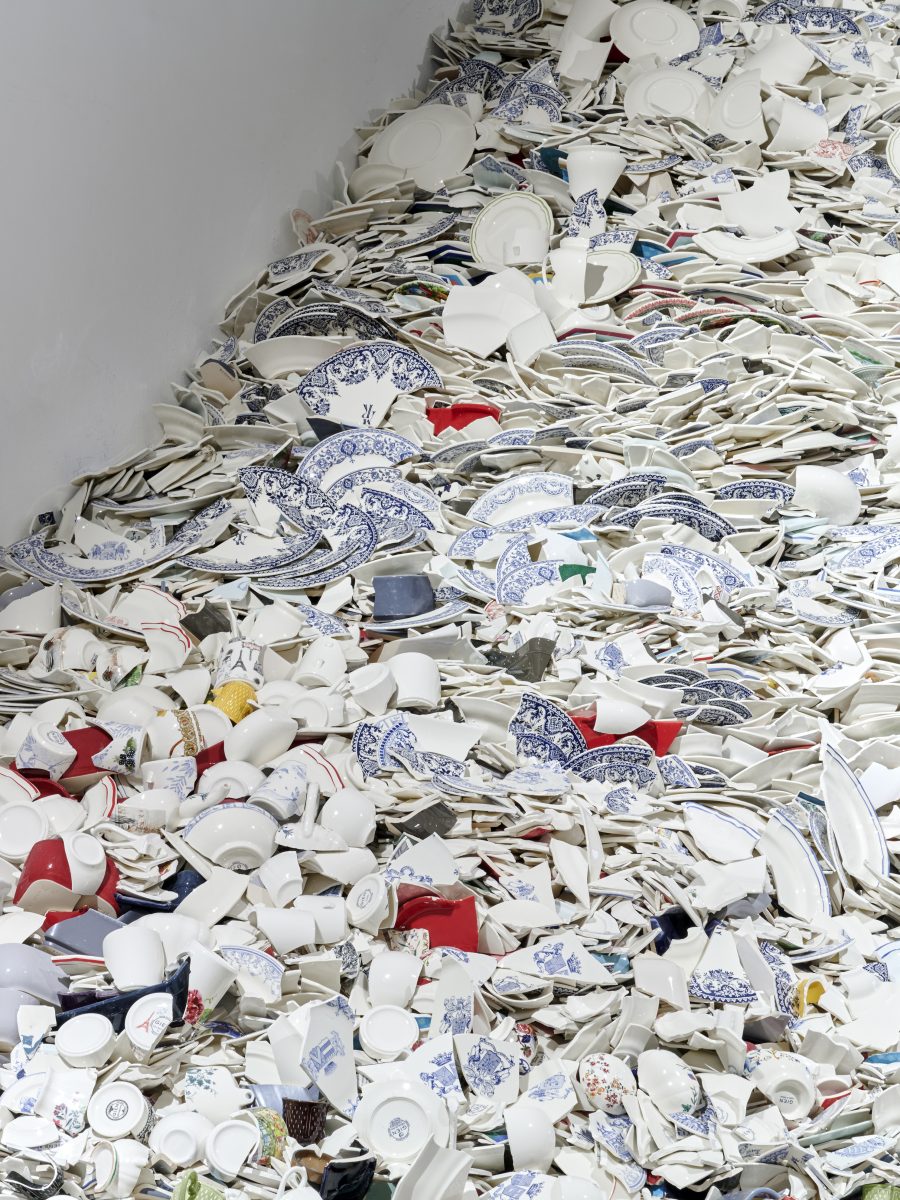
Clare Twomey | CLAY holding/transforming/performing, National Sculpture Factory, Cork, Eire, August 2023
Clare Twomey’s curation of CLAY holding/transforming/performing at the National Sculpture Factory, Cork, Eire (August 2023) created opportunities to witness the live practice of artists, alongside lectures and artists in conversation. Addressing clay as a site of production, negotiation and complexity, her curatorial aim was to develop ways to challenge fixed modes of clay practice by reimagining production through the demands of this ancient and enduring material.
Monument, Musee D’Art Moderne De Paris, France, Oct 2021 – 6 Feb 2022
Clare Twomey was commissioned by the Musee D’Art Moderne De Paris to make the entrance work, Monument, for the exhibition The Flames: The Age of Ceramics (15 Oct 2021 to 6 Feb 2022). Twomey’s vast sculpture examined the use and value of an array of tableware. Its collapsing movement raised contemporary questions of over-production, over-consumption and recycling. Oscillating between the functional and sculpture, as an introduction to the exhibition, the installation invited visitors to revise any preconceived ideas about ceramics and more specifically porcelain.
Factory: the seen and unseen, Tate Modern, UK, 2017–2018
At Tate Modern, Clare Twomey created Factory: the seen the unseen (2017 – 2018) transforming the space into a factory making everyday objects from clay. The idea of a factory refers to shared labour, with a production line composed of many parts and processes and where through shared goals a product is completed. This factory was a place of simulation with the intent of drawing visitors into a conversation about how we connect to our everyday ideas of labour, value and exchange.
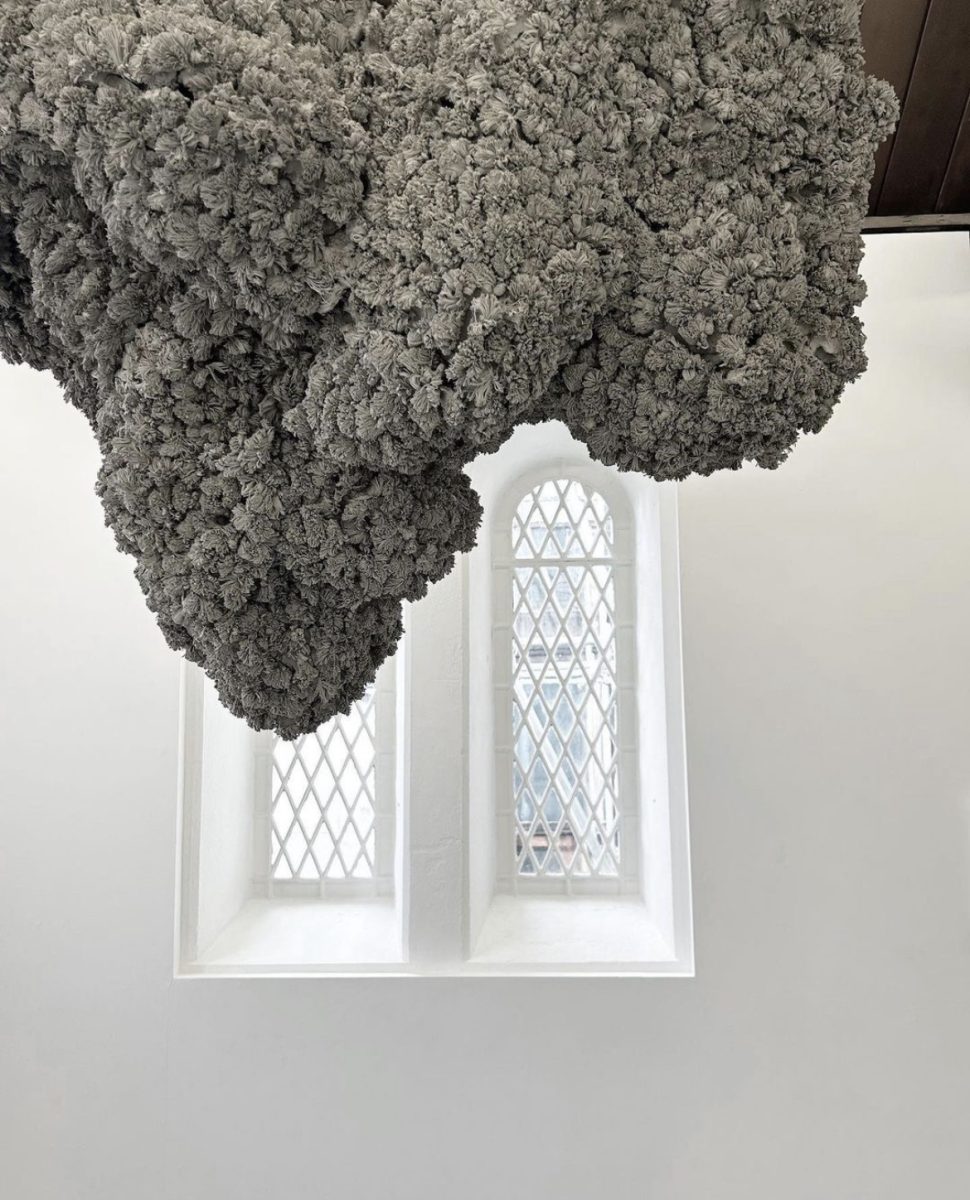
Phoebe Cummings | Deepfake Eden, Art Basel, Switzerland, June 2023.
Phoebe Cummings produced a new commissioned work for Arcual, presented at Art Basel, 2023. The temporary sculpture was acquired by Arcual, utilising their digital dossier feature to simultaneously archive and collect this ephemeral work in clay.
To Walk in the Image, Lismore Castle Arts, Cork, Ireland Mar-May 2023.
At the heart of the exhibition was an expanded view of the photographic medium. To Walk in the Image directly responded to the site of the gallery as a former chapel and ideas of spirituality, ritual and the land. Early Christian chapels were often built on ancient pagan sites of worship where respect was sewn into human behaviour around the rhythms by which the land breathes, grows, dies back, and rejuvenates. As part of the exhibition, Phoebe Cummings created a large hanging piece from raw clay titled Cumulus. Suspended in the middle of the chapel, the cloud-like mass sought to bring the earth inside, introducing the exterior to the interior. Alongside the sculptural work, Cummings presented a series of videos titled Towards a flower, revealing the intimate process of making by hand.
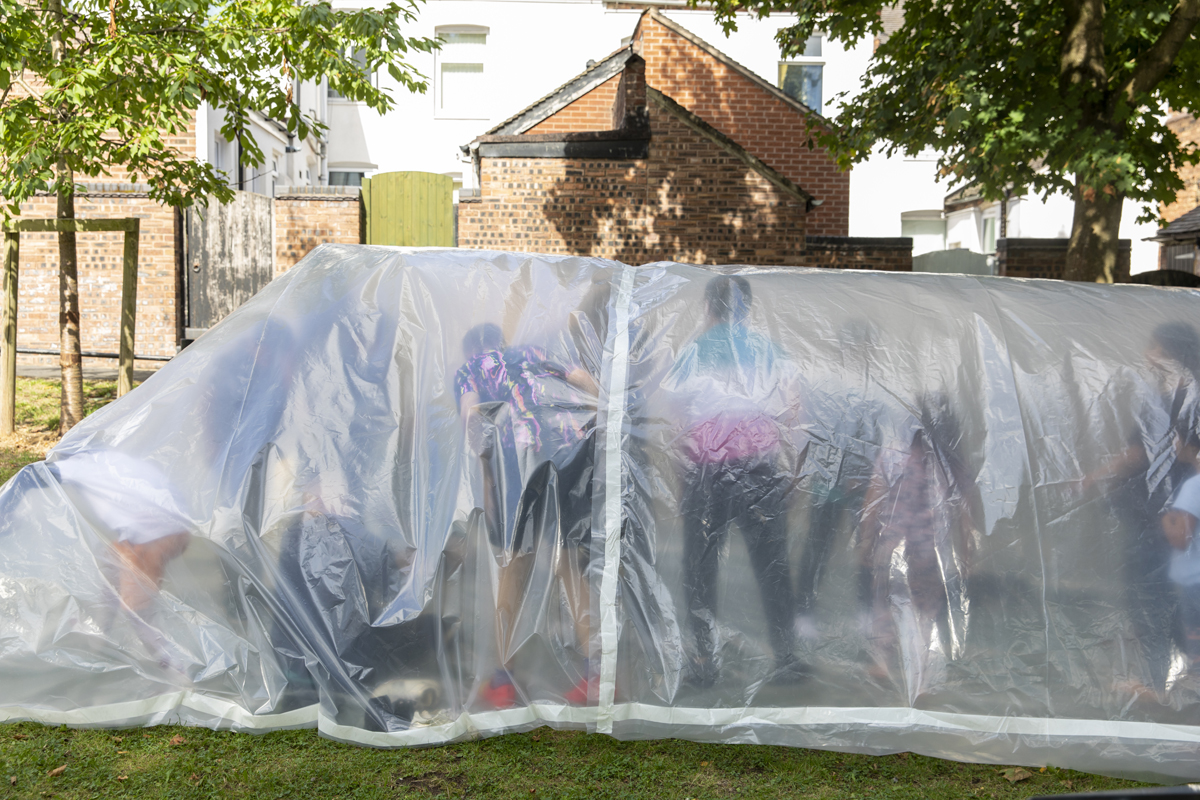
Tessa Peters | Song of the Wind, Yaksan, Republic of Korea, 2022 – 2023
Tessa Peters was Associate Curator and Researcher on Song of the Wind, an ecologically focused residency that engaged with the local people of Yaksan, a village in southwest Korea (2022 – 2023). The project, directed by Korean curator Sunyoung Oh and funded by Arts Council Korea, hosted artists from Ireland, Indonesia, Korea, Portugal, the Philippines and Thailand to develop artworks and activities in collaboration with the residents of Yaksan.
Look Who’s Talking, online/international, 2022 –
For the related socially collaborative online project Look Who’s Talking (2022 and ongoing) Tessa Peters took the role of Associate Curator (UK). This initiative, also directed by Sunyoung Oh, engages with a range of artistic, social, political and ecological themes raised by participants in Denmark, Germany, Indonesia, The Netherlands, The Philippines, South Korea, Thailand and the UK. The selected UK artists and collectives: Ceramics Research Centre-UK, Clayground Collective, The Portland Inn Project and Leap Then Look.
PROJECTS
Ceramics in the Expanded Field: Behind the Scenes at the Museum (2011–2014)
Ceramics in the Expanded Field was a 3-year project undertaken by the CRC-UK which produced the first critical overview of the relationship between contemporary ceramics and curatorial practice in museum culture through artistic collaboration with specific collections and the publication of critical writing.
Working closely with the Freud Museum in London, York Art Gallery and Plymouth City Museum and Gallery, the researchers examined how ceramic artists could animate museum collections in new ways. The in-depth project website published bi-monthly commissioned essays from key international writers in the field. Contemporary Clay and Museum Culture, an anthology of critical writing on ceramics and museology, published by Routledge, contextualised and defined the powerful relationship between ceramic practice and museology within the broader international arena of visual culture. A series of symposia, a major international conference and a major final exhibition were staged to draw attention to the significance of contemporary ceramic practice within museums and develop a wider audience for both areas.
SEMINARS
The international clay seminar series instigated by the CRC-UK with NYU in 2022 will be reprised in early 2024 with additional partners from the Ceramics Department of the Kwame Nkrumah University of Science and Technology, Ghana, and the Indian Ceramics Triennale.
Watch the 2022 seminars here:
Fragments & Dissonance
What is the Artwork?
Why Clay, Why Now
From Mumbai to South Kensington: A Shared History in Clay
CONTACT
Professor Clare Twomey – c.twomey@westminster.ac.uk