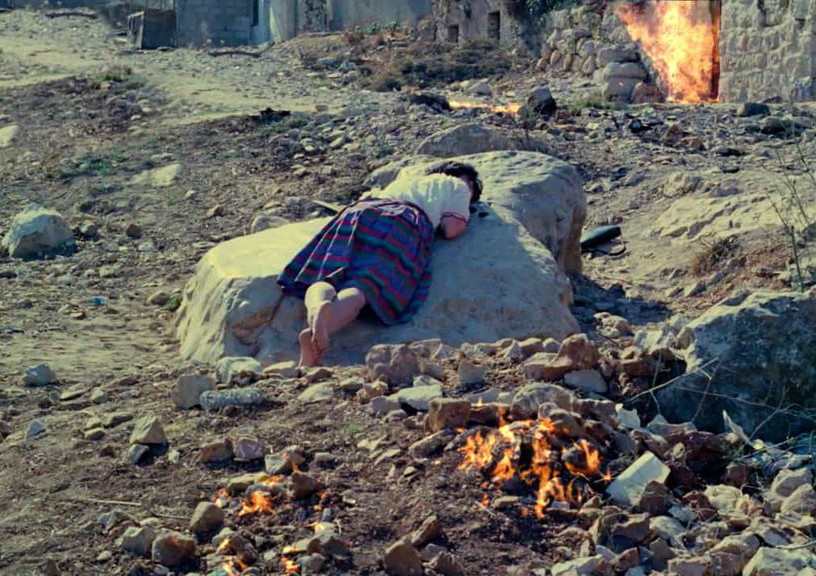
This programme brings together Susana de Sousa Dias and Kamal Aljafari in a dialogue on how political cinema transforms the archive into a tool of resistance. Both filmmakers work with images shaped by apparatuses of power and repression in order to shift their function and question the narratives they were intended to consolidate. Through the slowing down of images, editing, and the construction of sound counter-landscapes, they dismantle the ways of seeing inherited from these archives. While De Sousa Dias interrogates the propaganda mechanisms of the Portuguese dictatorship to make visible the traces of violence inscribed on bodies and memory, Aljafari rescues the fragmentary traces of a Palestinian history subject to dispossession and erasure. Their works thus transform the archive into a space of memory, confrontation, and historical reclamation, where the past becomes legible once more in the face of present urgencies.
17:00 – 18:17
Still Life (Natureza morta)
Susana de Sousa Díaz | Portugal, France | 2005 | 72’
De Sousa Dias revisits the archive of the Portuguese dictatorship, juxtaposing photographs of political prisoners with propaganda images produced by the regime. By extending the duration of the shots and dwelling on the faces, the film questions the apparent documentary transparency of these images. What once served to identify, monitor, or legitimise the regime becomes the object of a sustained gaze, revealing details and meanings beyond its original function. In this way, the film allows us to confront the dictatorship’s mechanisms of representation and to reclaim the subjectivity of those who were subjected to repression.
18:20 – 19:38
A Fidai Film
Kamal Aljafari | Germany, Palestine, Qatar, Brasil, France | 2024 | 78’
In A Fidai Film, Kamal Aljafari appropriates, among other materials, images from the Palestinian Research Centre that were looted by the Israeli army during the invasion of Beirut in 1982. The film confronts the dispossession of Palestinian visual memory and questions the power relations that determine who is able to preserve and narrate their own history. Working with these materials, Aljafari asserts Palestinian presence in the face of attempts to erase it and reclaims a visual legacy that was taken away. Cinema thus becomes a form of symbolic restitution.
19:45 – 20:45
Roundtable | The counter-archive: images, memory and resistance
This roundtable invites both filmmakers to reflect on archival cinema as a tool of political resistance, capable of challenging official narratives, recovering silenced memories, and confronting the violence of the past. A space to engage in dialogue about images, power, and the ways in which history is narrated.