Following a masterclass by Professor Joshua Oppenheimer at Regent Street Cinema, CREAM PhD researcher Kay Min Soh reflects on Oppenheimer’s latest fiction feature The End and how it speaks to its precursors, the documentaries The Act of Killing and The Look of Silence.
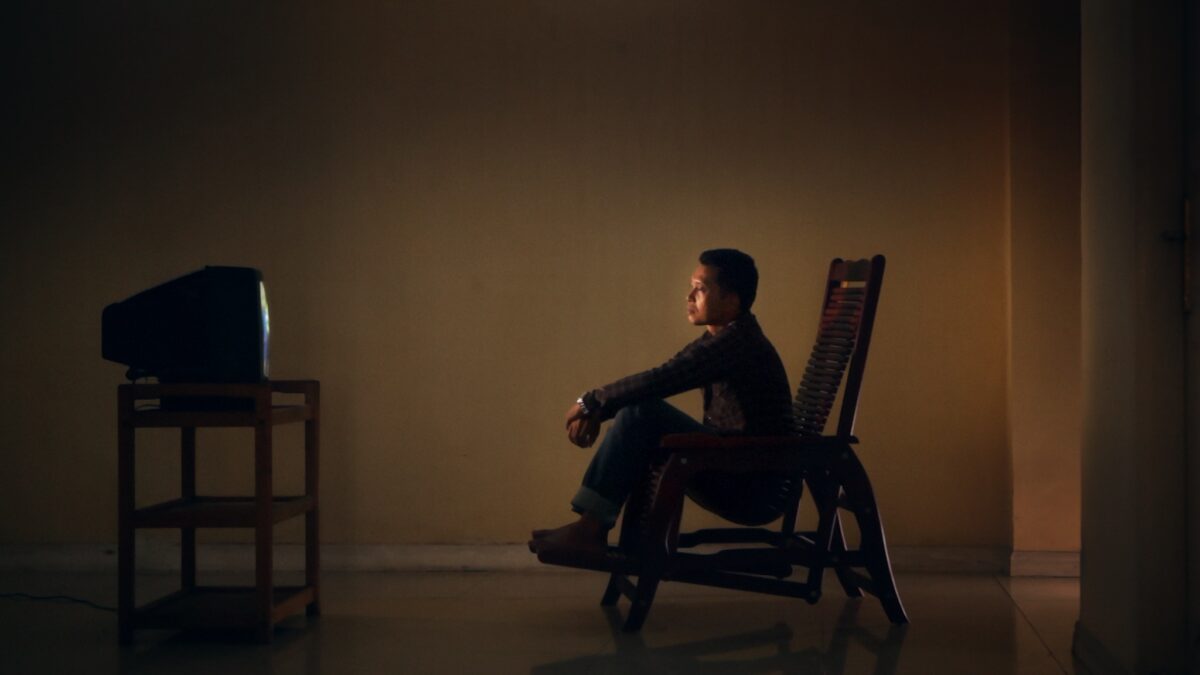
Before The End (2024), Joshua Oppenheimer had made two films about guilt and genocide. Centred on testimonies and reenactments of the 1965–66 Indonesian anti-communist purge, The Act of Killing (2012) and The Look of Silence (2014) delved into the memories of survivors and perpetrators alike. Yet the word “memories” seems somehow insufficient—as if memory were a tidy receptacle in which the past is boxed up with a lid that can be lifted whenever an urge arises, and then shut closed again whenever its contents threaten to take over the present. Perhaps it would be better to say that memory is a convex lens through which Oppenheimer’s films are shot and their scenes recursively restaged. Perhaps, rather, we could say that his films are portraits of an impasse with impunity; portraits of presents that are always already prefigured by their pasts. Perhaps they are films about the ghosts who linger long into the fabric of the future and the living who go on living, suspended in liminal states between fever dreams of denial and the facts of trauma; films about the histories that haunt us and the fabrications of memory we rehearse into reality.
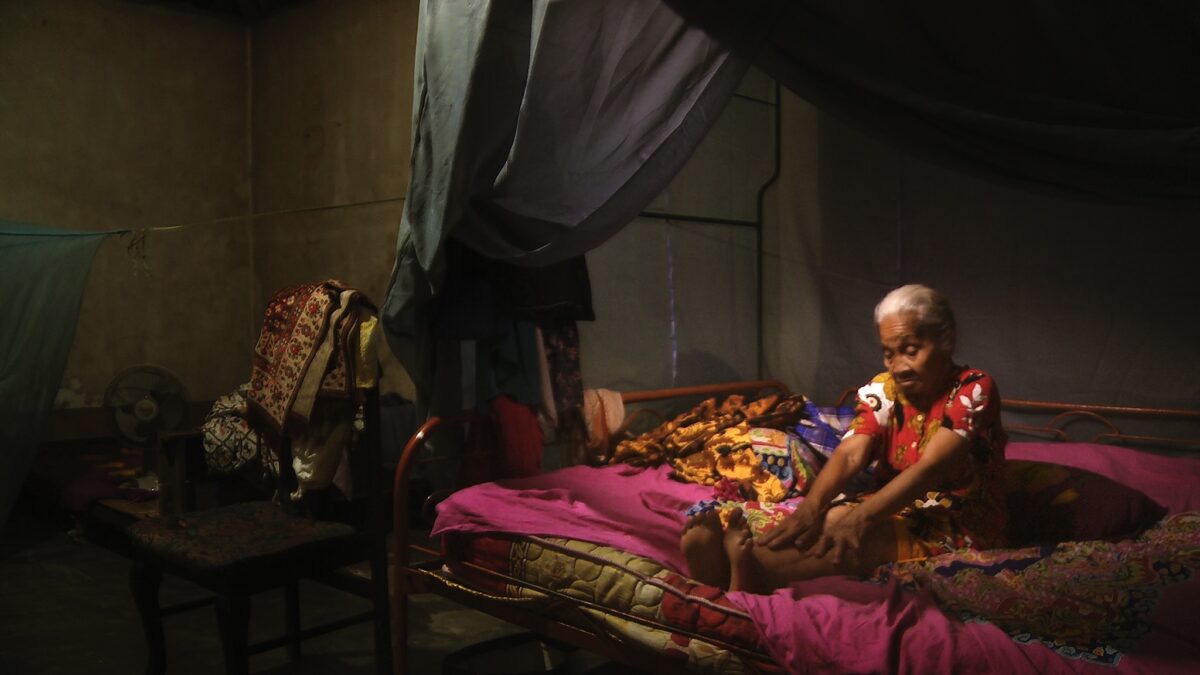
Your mom misses you, Ramli.
I haven’t seen you for so long.
I still see you in my dreams.
You can see me, but I can’t see you.
I wish I could see you.
—The Look of Silence (2014)
The end is nowhere in sight. In The Look of Silence, Ramli’s mother, Rohani, continues to speak as if his spirit is still present and watching. Ramli Rukun had been murdered decades ago during the Indonesian genocide of 1965–66, by a paramilitary death squad in the North Sumatran oil plantation belt near the city of Medan. They never found a body, only bones. Ramli’s killers were never held to account. His youngest brother, Adi, spends his lifetime navigating the silence left in the wake of unaccountability. As The Act of Killing comes to an end, a killer breaks down on camera. As The End comes to its end, Mother looks into the distance with Girl, the mother of Son’s newborn child, a new Mother. It has been twenty-five years after the world met its end from warmongering self-destruction and environmental collapse, and many more since the aftermath of the 1965 Indonesian genocide. The mothers stand with their backs to the audience, staring unseeingly into the dark stretch of tunnel before them. The end is still nowhere in sight.
Before the end became The End, Oppenheimer had planned to make a third film in Indonesia, about immortality-obsessed oligarchs who emerged from the repressive terror of Suharto’s thirty-year New Order regime (1966–1998), and whose fortunes grew on the graveyard of the biggest mass massacre in Indonesian history.1 This finale of his would-be Indonesian trilogy will perhaps never be realised, as Oppenheimer has been banned from entering the country since the release of his first two documentary features. Luckily, oligarchs with a penchant for boasting seem to be of a cosmopolitan stripe, and Oppenheimer soon found new, willing collaborators in several other super-wealthy denizens of other counties, all preparing to outlive the rest of the world in doomsday bunkers made to replicate an everlasting present. It is worthwhile to note that despite spending over a decade of his life making films in and about impunity in Indonesia, Oppenheimer has said from the outset that The Act of Killing—and from here we could fairly extrapolate, The Look of Silence as well—was never “only a story about Indonesia,” but rather “a story about us all.”2 Perhaps it is thus only logical that after two documentary films exploring the embodied aftermath of mass killing, the disembodied, histrionic horizon of immortality would become the site of Oppenheimer’s next cinematic excavation. Perhaps against all logic, a “post-apocalyptic musical”—to borrow the preferred tagline of online film critics3—set in the disquieting “non-place”4 of an unspecified underground fortress, was the only sensible finale to Oppenheimer’s genre-bending trilogy of guilt and cognitive dissonance.
Oppenheimer is of the opinion that musicals, with what he calls their “naïve certainty,” are the ultimate mirrors to our inner selves. He talks about his films as mirrors to the truths we do not want to see. While The End is not a film that explicitly confronts a specific genocidal regime, its screening in conjunction with The Act of Killing and The Look of Silence, at a moment in time in which the truth of genocide is broadcast before our eyes with unprecedented clarity, spells out an unsaid connection that is plain to see. And yet, there are some who still refuse to see. With The End, Oppenheimer created a film through which we are made to look at ourselves—or who we could become. In his director’s statement about The End, Oppenheimer writes that it is the very “honesty” of the musical genre that makes it “the ideal form…for getting viewers to feel the tragic consequences of the musical’s own escapist sentimentality.”5 He continues:
This is particularly so if the characters survive by lying to themselves. In The End, the family faces doom with desperate, misbegotten optimism. The classic Hollywood musicals of Vincente Minnelli, Gene Kelly, and Busby Berkeley form, collectively, cinema’s most optimistic genre. Nowhere else do we see such naive certainty in the world’s ultimate harmony (created, it should be noted, right when humanity developed the ability to destroy itself, and the planet, at the push of a button).
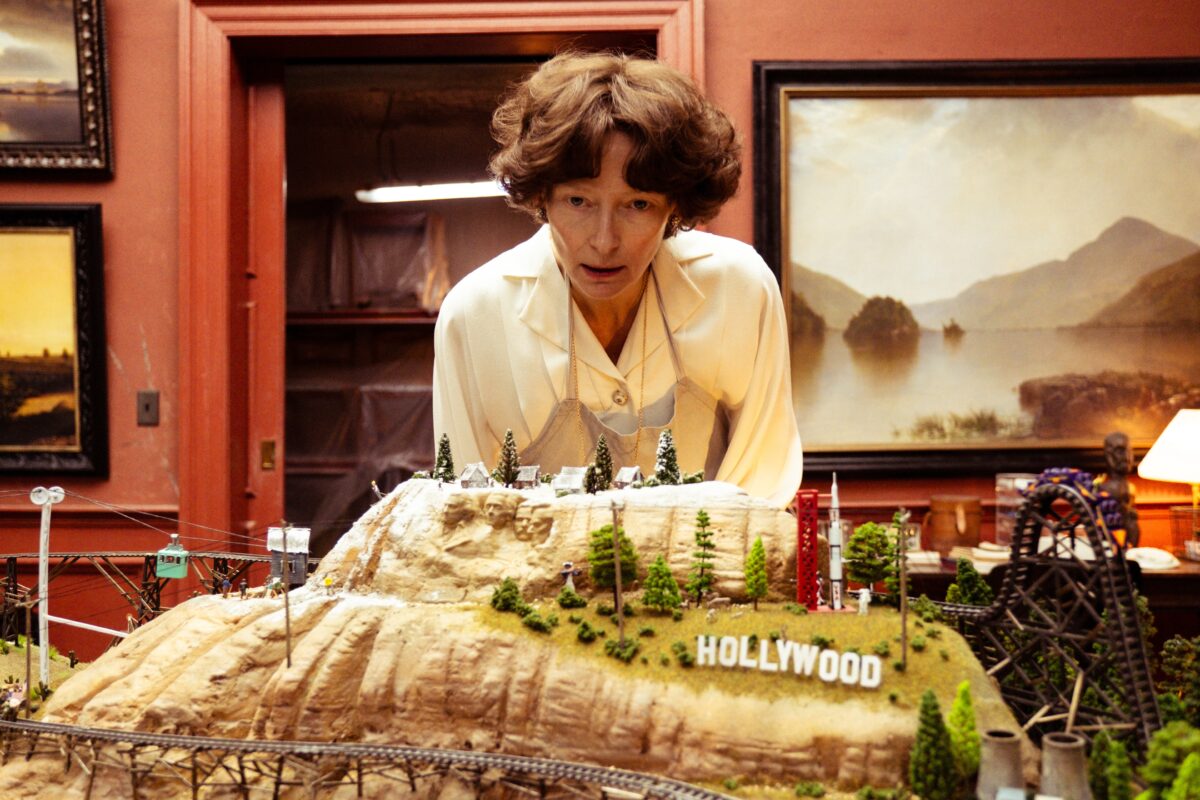
If The Act of Killing is a portrait of impunity and The Look of Silence a poem of living through it—as in Oppenheimer’s own words—then perhaps The End is a brutal reflection, a charade of our ugliest truths. And perhaps the musical climax of this unlikely triptych was already foreshadowed from the conception of its first panel. The Act of Killing is best remembered for its final musical number, acted out—of their own escalating, lurid accord—by former death squad members with a lifelong love for Hollywood Westerns and musicals. It is no accident that in Medan, where The Act of Killing and The Look of Silence were filmed, these paramilitary death squads constituted of local “movie theatre gangsters,” recruited specifically by Suharto’s right-wing military dictatorship for their violent track records and hatred of Hollywood-boycotting leftists—a cinematic culture that the gangsters not only adored, but also relied on for black-market ticket sales to operate the movie theatres that doubly acted as the backstage for their criminal livelihoods.6 Oppenheimer’s award-winning first feature which starred some of these gangsters, including Anwar Congo as the lead character, was a result of the Genocide and Genre research project that he developed in collaboration with the late Joram ten Brink at CREAM from 2005 to 2011. Building on ten Brink’s research on the role of reenactment in documentary filmmaking and seeking to “stage a series of ‘perverse’ performances of official history that will name it and give it substance,” Oppenheimer gave the perpetrators “free reign to declaim their pasts for [the] camera, in invariably generic terms (in ‘testimonial’ interviews, reenactments, and even musicals).”7
In the wake of the 30 September Movement in Indonesia in 1965, anyone who was deemed a communist sympathiser was to be systematically dispatched. The exact number of killings is not known—estimates range between 500,000 to 2,500,000—but it is on the record that within a span of six months, 10,500 people were killed by just two death squads in North Sumatra.8 As the opening scene of The Look of Silence narrates: “Anybody opposed to the military dictatorship could be accused of being a communist: union members, landless farmers and intellectuals. In less than a year, over one million ‘communists’ were murdered—and the perpetrators still hold power throughout the country.” Across the so-called Global South, the spectre of the communist bogeyman was being conjured, endorsed and supported by the United States and its Cold War allies, and quietly enabled by a densely networked “Free World” ideological apparatus of intelligence agencies, parachuting diplomats, local economic elites, and media moguls. Indonesia was no exception. This would spell the end of the heyday of the Indonesian anti-colonial independence movement under Sukarno’s leadership, during which the Indonesian Communist Party (PKI) held onto the vestiges of political influence while a decolonial dream of non-alignment was awakening in Bandung.9 In a 2013 essay unpacking the complex political underbelly of the cultural Cold War in Indonesia and the resulting psyche of Medan’s ageing movie gangster “heroes,” the late Benedict Anderson offered a way to understand how The Act of Killing could have allowed them to actualise their—in their own view—underrecognised heroism, through scenes such as the film’s spectacular and profoundly disturbing musical number: “Oppenheimer [thus] comes to them as a providential ‘Hollywood’ ally. They will die soon, but maybe he will make them immortal.”10
It is worth bearing in mind that even in the early 2000s, in an Indonesia freshly unburdened from the weight of Suharto’s dictatorship, the “official history” Oppenheimer spoke of still bore no mention of the mass killings that paved the way for the establishment of the New Order regime. This has largely been attributed to the overwhelming success of Suharto’s propaganda campaign, the star of which was undeniably the 1984 four-hour blockbuster film Pengkhianatan G30S/PKI, a misogynistic admixture of “documentary exposé, political thriller and slasher movie”11 that became nation-wide mandatory viewing for twenty-four years until Suharto’s resignation in 1998. G30S portrayed the attempted coup of September 1965 as masterminded by an evil and sadistic woman-led communist mob, whose graphic murder of six army generals serve as the story’s climactic end. Stopping short of any on-screen acknowledgement of the mass killings that followed, the film allowed the ensuing fact of genocide to linger as an unspoken terror. This choice of cinematic cut also excluded from the credits the Hollywood-loving gangsters who carried out the actual, chillingly mundane acts of killing.
Should there be a “narrative arc” to The Act of Killing, it arguably follows the escalation of Anwar Congo’s theatrical reenactments of his boastful recollections of how he and his death squad members carried out their killings. It should further be remembered that these gangsters
explicitly fashioned themselves—and their methods of murder—after the Hollywood stars who were projected on the screens that provided their livelihood. Coming out of the midnight show, they describe feeling “just like gangsters who stepped off the screen.” In this heady mood, they strolled across the boulevard to their office and killed their nightly quota of prisoners, using techniques directly borrowed from movies.12
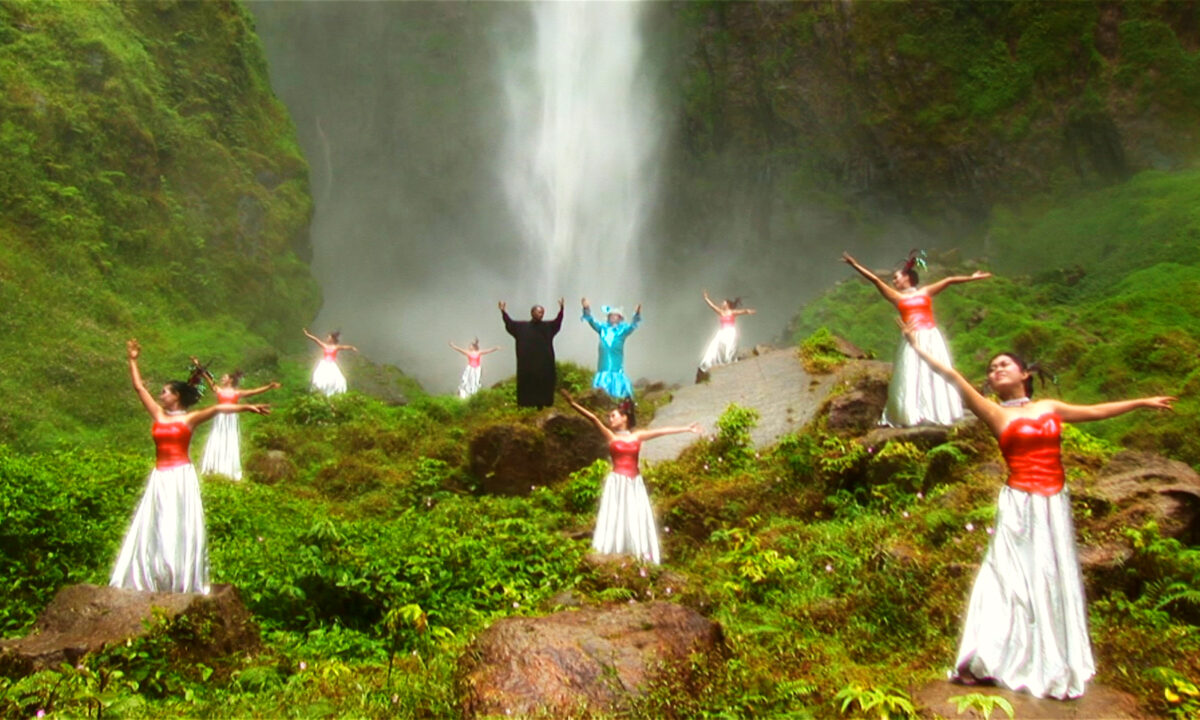
After watching film rushes of himself reenacting his killings, Congo would suggest even more dramatic renditions—all while the camera was still rolling— until he arrived at their final, most cinematically surreal and melodramatically charged iteration that became the film’s defining musical number. In parallel, in his village home just miles away, Adi Rukun was watching all these rushes as well. Years of watching Oppenheimer’s footage of Congo and his cronies testifying to their killings—including the murder of his older brother Ramli—would lead to Adi’s eventual confrontation of the killers in The Look of Silence. These methods of filmic feedback and performative reenactment used by Oppenheimer in the making of his first two films would be further developed and reframed as “self-staging and recursive reflexivity” in the course of his follow-up CREAM research project Documentary of the Imagination with Professor Rosie Thomas, the results of which contributed to the making of The End.
Since October 2023, on a timeline not dissimilar to that of the filming of The End, at least 67,000 Palestinians have been killed by the IDF within two years of an ongoing genocide in Gaza, with thousands of others injured or still buried under the rubble.13 The images of the death and destruction coming out of Gaza are apocalyptic to say the least, but perhaps more so are the fictions and fantasies being projected upon them. And while architectural renders created with the help of artificial intelligence reimagined the Gaza Strip as luxury riverfront real estate, Oppenheimer was procuring stories of oligarchs’ post-apocalyptic bunker dreams and rehearsing them into musical truth-telling with an impressive cast of actors (among them Tilda Swinton). In an interview about The End, Oppenheimer astutely commented:
The Act of Killing and The Look of Silence both emphasize a kind of continuity with an apocalypse. A genocide takes place, and we are left with the lies and fantasies imposed by the perpetrators. And I think The End is demanding an intervention rooted in self-reflection and honesty. Apocalypse is not just the end of the world, it’s equally a distillation of our destructive behaviour in the present because we’re already after the end – we’re already living in the bunker. And what is that bunker really about? It’s about lies, and stories, and self-deception rooted in shame, or an inability to face the truth. We give ourselves permission to fill a hole – we place ourselves; we re-inscribe, we re-enforce the walls.14
When the capitalist death drive of impunity has consumed itself and we are left on an Earth devoid of life and irreparably robbed of all its resources, it is likely that we will not know, either, the exact number of lives claimed, both human and more-than-human. If the hyper-present “communist threat” was the unsung and unseen protagonist of Oppenheimer’s two films on the Indonesian genocide, then capitalism must be The End’s unnamed antagonist-at-large—amorphous, shapeshifting, ever-present in all its all-consuming, unhuman, inhuman forms. The cavernous underground palace, adorned with artificial skylights. The shining dinnerware. The sparkling chandelier. The kitschy American luminist paintings. Father’s unreliable narration of his slippery, oil-soaked memoirs, his absurd and abiding appreciation of fine wine. Mother’s druggy, dissociative gaze, her secrets and mercurial mood swings. Son’s clueless libido and hapless affections. Girl’s otherness, her eventual assimilation.
“Whenever the official history is rehearsed, its obscenity operates; the cast of official characters conjures a spectral host that haunts offstage,” wrote Oppenheimer in his doctoral thesis on the Indonesian genocide in 2004. In the same way that The Act of Killing and The Look of Silence were not so much films about Indonesia in 1965 as they were films about Indonesia in the shadow of that history, The End is perhaps not so much a projection into a postapocalyptic future as it is a film about the spectral present that persists in haunting its underground stage, against its characters’ best efforts to overwrite it. “The script,” as it was then and as it is now, “is deliberately and necessarily incoherent, and it is not concerned with adequacy to actual events. It is not a history in the realist register. It is not recounted in order to refer; rather, it is rehearsed in order to exercise a power. It is a history in the performative register.”15
ACKNOWLEDGEMENTS
Special thanks go to Matthias Kispert for the insightful editorial feedback, Professors May Adadol Ingwanij and Rosie Thomas for the opportunity to work on this project, and last but not least, Professor Joshua Oppenheimer, for the filmic mirrors he brings into the world.
ENDNOTES
1 For a detailed account of the 1965 coup that paved the way for Suharto’s New Order regime, see Benedict Anderson and Ruth McVey’s “A Preliminary Analysis of the October 1, 1965, Coup in Indonesia.” Cornell University Southeast Asia Program, 1971. For further reading on how violence unfolded throughout the Suharto regime, see Anderson’s edited volume Violence and the State in Suharto’s Indonesia, Cornell University Southeast Asia Program, 2001.
2 Joshua Oppenheimer, Director’s Statement, The Act of Killing, 2012.
3 Examples include Valeria Berghinz, “Joshua Oppenheimer’s The End: Between Musical and Mirror,” The Cold Magazine; Peter Bradshaw, “The End review – Tilda Swinton end-of-the-world singalong drama commands attention,” The Guardian, 26 March 2025; Wendy Ide, “The End review – post-apocalyptic musical with Tilda Swinton is catastrophically self-indulgent,” The Guardian, 30 March 2025; Christopher Reed, “A Conversation with Joshua Oppenheimer (The End),” Hammer to Nail, 13 December 2024.
4 Marc Augé, Non-places: An Introduction to Supermodernity, (Verso, 2015).
5 Joshua Oppenheimer, Director’s Statement, The End, 2024.
6 Joram ten Brink and Joshua Oppenheimer, “Introduction,” in Killer Images: Documentary Film, Memory, and the Performance of Violence, (Columbia University Press, 2013), 2.
7 Joshua Oppenheimer and Michael Uwemedimo, “Show of Force: A Cinema-Séance of Power and Violence in Sumatra’s Plantation Belt,” in Killer Images: Documentary Film, Memory, and the Performance of Violence, (Columbia University Press, 2013), 291.
8 Ibid.
9 The Bandung Conference of 1955 was a historic meeting of newly independent Asian and African states, who had come together to discuss a collective strategy of non-alignment in the face of building pressure from the two Cold War superpowers, the capitalist ‘Free World’ bloc led by the United States, and the communist Soviet bloc. Richard Wright’s The Color Curtain (World Publishing Co., 1956), and Brian Russell Roberts and Keith Foulcher’s edited companion Indonesian Notebook (Duke University Press, 2016), provide critical historical accounts.
10 Benedict Anderson, “Impunity,” in Killer Images: Documentary Film, Memory, and the Performance of Violence, (Columbia University Press, 2013), 283. In a way, The Act of Killing did “make them immortal.” For the first time, Anwar Congo and his gang were interviewed about the killings on Indonesian national television, and praised for exterminating the “communist threat” with “humane” killing methods.
11 Oppenheimer and Uwemedimo, “Show of Force,” 289.
12 ten Brink and Oppenheimer, “Introduction,” 2.
13 Marium Ali, Alia Chughtai and Muhammet Okur, “Two years of Israel’s genocide in Gaza: By the numbers,” Al Jazeera, 7 October 2025, https://www.aljazeera.com/news/2025/10/7/two-years-of-israels-genocide-in-gaza-by-the-numbers. Despite the announcement of a second ceasefire on 10 October 2025, at least 379 more Palestinians have been killed in ceasefire violations. AJ Labs, “How many times has Israel violated the Gaza ceasefire? Here are the numbers,” Al Jazeera, 11 November 2025 (updated 10 December 2025), https://www.aljazeera.com/news/2025/11/11/how-many-times-has-israel-violated-the-gaza-ceasefire-here-are-the-numbers
14 Lucy Peters, “Joshua Oppenheimer: ‘The End is an artefact of barbarism’,” Little White Lies, 25 March 2025, https://lwlies.com/interviews/joshua-oppenheimer-the-end-is-an-artefact-of-barbarism
15 Joshua Oppenheimer, “Show of Force: films, ghosts and genres of historical performance in the Indonesian genocide,” (PhD thesis, University of the Arts London, 2004), 10.
REFERENCES
AJ Labs. “How many times has Israel violated the Gaza ceasefire? Here are the numbers.” Al Jazeera. 11 November 2025 (last updated 10 December 2025). https://www.aljazeera.com/news/2025/11/11/how-many-times-has-israel-violated-the-gaza-ceasefire-here-are-the-numbers.
Ali, Marium, Alia Chughtai and Muhammet Okur. “Two years of Israel’s genocide in Gaza: By the numbers.” Al Jazeera, 7 October 2025. https://www.aljazeera.com/news/2025/10/7/two-years-of-israels-genocide-in-gaza-by-the-numbers.
Anderson, Benedict and Ruth McVey. A Preliminary Analysis of the October 1, 1965, Coup in Indonesia. Cornell University Press, 1971 [1965].
Anderson, Benedict (ed). Violence and the State in Suharto’s Indonesia. Cornell University Press, 2001.
Anderson, Benedict. “Impunity.” In Killer Images: Documentary Film, Memory and the Performance of Violence, edited by Joram ten Brink and Joshua Oppenheimer. Columbia University Press, 2013, p.268–286.
Augé, Marc. Non-places: An Introduction to Supermodernity. Verso, 2015.
Berghinz, Valeria. “Joshua Oppenheimer’s The End: Between Musical and Mirror,” The Cold Magazine. https://thecoldmagazine.co.uk/oppenheimer-the-end/.
Bradshaw, Peter. “The End review – Tilda Swinton end-of-the-world singalong drama commands attention.” The Guardian, 26 March 2025. https://www.theguardian.com/film/2025/mar/26/the-end-review-end-of-the-world-singalong-drama-commands-attention.
ten Brink, Joram and Joshua Oppenheimer. “Introduction.” In Killer Images: Documentary Film, Memory and the Performance of Violence, edited by Joram ten Brink and Joshua Oppenheimer, Columbia University Press, 2013, p.1–14.
Ide, Wendy. “The End review – post-apocalyptic musical with Tilda Swinton is catastrophically self-indulgent.” The Guardian, 30 March 2025. https://www.theguardian.com/film/2025/mar/30/the-end-review-joshua-oppenheimer-post-apocalypse-musical-catastrophically-self-indulgent-tilda-swinton.
Noer, Arifin C., dir. Pengkhianatan G30S/PKI. Perum Produksi Film Negara, 1984.
Oppenheimer, Joshua. “Show of Force: films, ghosts and genres of historical performance in the Indonesian genocide.” PhD diss., University of the Arts London, 2004.
Oppenheimer, Joshua. Director’s Statement, The Act of Killing, 2012 [unpublished].
Oppenheimer, Joshua. Director’s Statement, The End, 2024 [unpublished].
Oppenheimer, Joshua, dir. The End. Neon, 2024.
Oppenheimer, Joshua, Christine Cynn, and anonymous, dir. The Act of Killing. Final Cut for Real, 2012.
Oppenheimer, Joshua, and anonymous, dir. The Look of Silence. Drafthouse Films and Participant Media, 2014.
Oppenheimer, Joshua and Michael Uwemedimo. “Show of Force: A Cinema-Séance of Power and Violence in Sumatra’s Plantation Belt.” In Killer Images: Documentary Film, Memory and the Performance of Violence, edited by Joram ten Brink and Joshua Oppenheimer, Columbia University Press, 2013, p.287–310.
Peters, Lucy. “Joshua Oppenheimer: ‘The End is an artefact of barbarism.’” Little White Lies, 25 March 2025. https://lwlies.com/interviews/joshua-oppenheimer-the-end-is-an-artefact-of-barbarism.
Reed, Christopher. “A Conversation with Joshua Oppenheimer (The End).” Hammer to Nail, 13 December 2024. https://www.hammertonail.com/interviews/joshua-oppenheimer/.
Roberts, Brian Russell and Keith Foulcher (eds). Indonesian Notebook: A Sourcebook on Richard Wright and the Bandung Conference. Duke University Press, 2016.Wright, Richard. The Color Curtain: A Report on the Bandung Conference. World Publishing Co., 1956.